
I remember fabricators waiting as long as 30 minutes just to get the paperwork for their next job.
They had finished the previous one. But the next packet wasn’t ready, or the supervisor wasn’t nearby.
Then came finding material and preparing parts.
When I joined the company, each fabricator cut their own parts. That included our most experienced people, whose knowledge was needed for difficult fabrication work. Sometimes preparing material meant going outside the building.
The company had previously had a kitting department. It had been abandoned because of too many errors.
I started working on bringing it back.
Bringing kitting back
We began developing SOPs and assigned a newer employee who understood the material and picked things up quickly. He prepared parts from engineering orders, arranged them on tables, and scanned material to record its issue.
It was demanding work. Engineering orders were not always correct. Experienced fabricators also had their own ways of building the same product.
We needed shared preparation rules. For aluminum, that could mean leaving a small allowance for the fabricator to shave to fit. Steel parts were generally cut to size.
The new employee cared about getting things right, but he made mistakes. Experienced fabricators protested. Their concerns had a history behind them: they had seen kitting fail before.
Some preferred to keep cutting their own parts. Eventually, we allowed exceptions for some of the most experienced people. Most fabricators accepted the prepared kits, despite the remaining problems.
Kitting was working again, but agreement on how everyone would use it remained incomplete.
Preparing the handoff
Kitting became part of a wider change to the handoff between jobs.
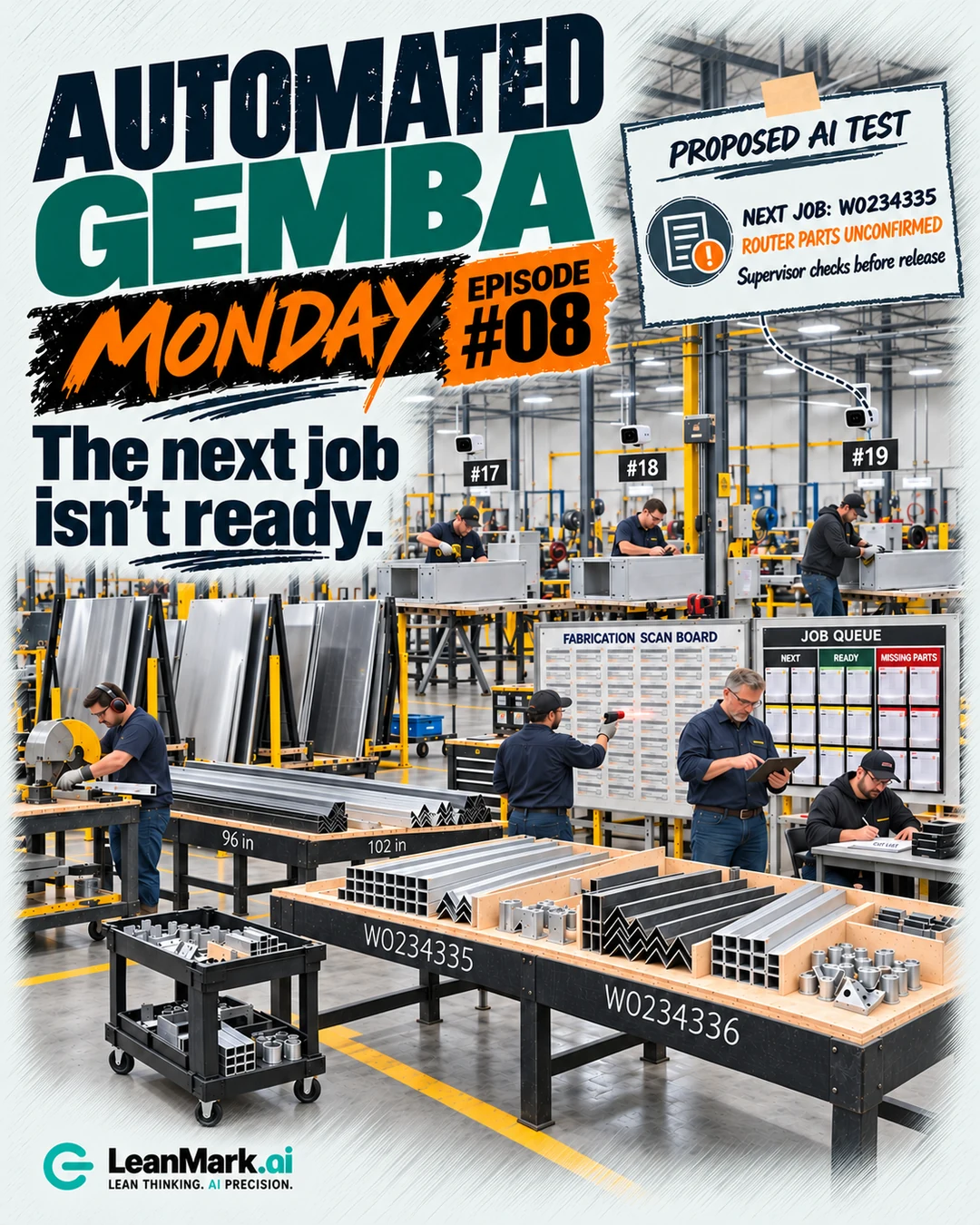
The supervisor set the sequence and prepared the paperwork. The kitting employee prepared the parts. A scheduling board with document pockets gave fabricators a place to collect their next assignment.
We generally tried to have two jobs prepared.
That did not mean every kit was complete. A part might be missing, defective, or still waiting to arrive from the router.
When a fabricator encountered a problem, they reported it to the supervisor. The paperwork went into a separate pocket for missing parts, and the fabricator could take the next job.
The supervisor was responsible for following up with kitting or the department involved.
From the floor, I could see less walking, searching and waiting between jobs. Fabricators spent more time at their workstations. Organizing the factory also made parts preparation easier.
We did not measure the time reduction. This was my observation, not a measured productivity result.
There was still a weakness.
The supervisor had a lot to manage. Putting paperwork in the missing-parts pocket did not guarantee that someone would return to it. Some jobs stayed there too long.
Having another job available kept the fabricator working. It did not automatically get the blocked job finished.
Where I would test proactive AI
Today, I would propose a small experiment focused on the next jobs in the supervisor’s queue.
Could AI help identify a readiness problem early enough for someone to act before the fabricator finishes the current job?
This was not part of the system we implemented then.
I would first check what information was available and how much effort it would take to keep it current. Material scanning existed, but that alone would not tell us whether the paperwork was ready or every required part was usable.
For the experiment, we would need a shared definition of “ready” and a practical way to update the relevant statuses.
AI could then compare the upcoming jobs with those updates and highlight gaps.
An illustrative alert might read:
This job is next in the queue. Paperwork is ready, but the kit is marked incomplete. Router parts have not been confirmed. Check their status before releasing the job.
The supervisor could investigate while the fabricator was still working on the current assignment. They might arrange the missing parts or change the sequence.
Once someone agreed to a next action, the system could track it. If the expected update did not arrive, the issue would come back for attention.
For jobs already in the missing-parts pocket, it could keep the unresolved shortage visible until someone confirmed that the required parts were ready. The supervisor would then decide when to return the job to the queue.
Start with a simple standard
Before adding AI, I would establish a basic routine: record when a job becomes blocked, assign responsibility for the next action, and review blocked jobs at a fixed time.
That routine might solve a substantial part of the problem. It would also give us a baseline for the experiment.
A dated reminder does not require AI. AI would need to earn its place by helping interpret scattered updates and connect them to the right jobs.
For example, a department’s update might describe a part or an operation without clearly stating which upcoming job it affects. AI could propose that connection and flag uncertainty for a person to check.
That benefit would have to outweigh the effort of maintaining the information. The kitting employee already had preparation and material-issuing work to do.
People confirm readiness
The responsibilities would stay explicit.
The fabricator reports a missing part or a fit or quality problem. Kitting and the supplying departments confirm what is physically available and report unresolved issues.
The supervisor decides priorities, coordinates the response, and authorizes the job to proceed.
AI brings the updates together and points out gaps early enough to support those decisions.
A scanned part is not necessarily the correct part. A complete list is not proof of a usable kit.
People still need to verify the physical work. If a status is unknown, the system should show it as unknown.
What would count as a useful result?
Before the AI trial, I would measure the process with the basic review routine in place. Then I would compare:
- How often shortages are discovered before a job reaches the workstation.
- How much waiting between jobs is caused by missing paperwork or parts.
- How long blocked jobs remain unresolved.
I would also record the effort required to maintain updates and whether the alerts led to useful action.
The experiment would be worthwhile if it gave the supervisor time to resolve more problems before they interrupted the next job, while keeping existing blocked work from being forgotten.
The kitting changes helped people spend more time on fabrication. The next opportunity is to make readiness more dependable.
Can AI give people enough notice to make the next job ready before it is needed?