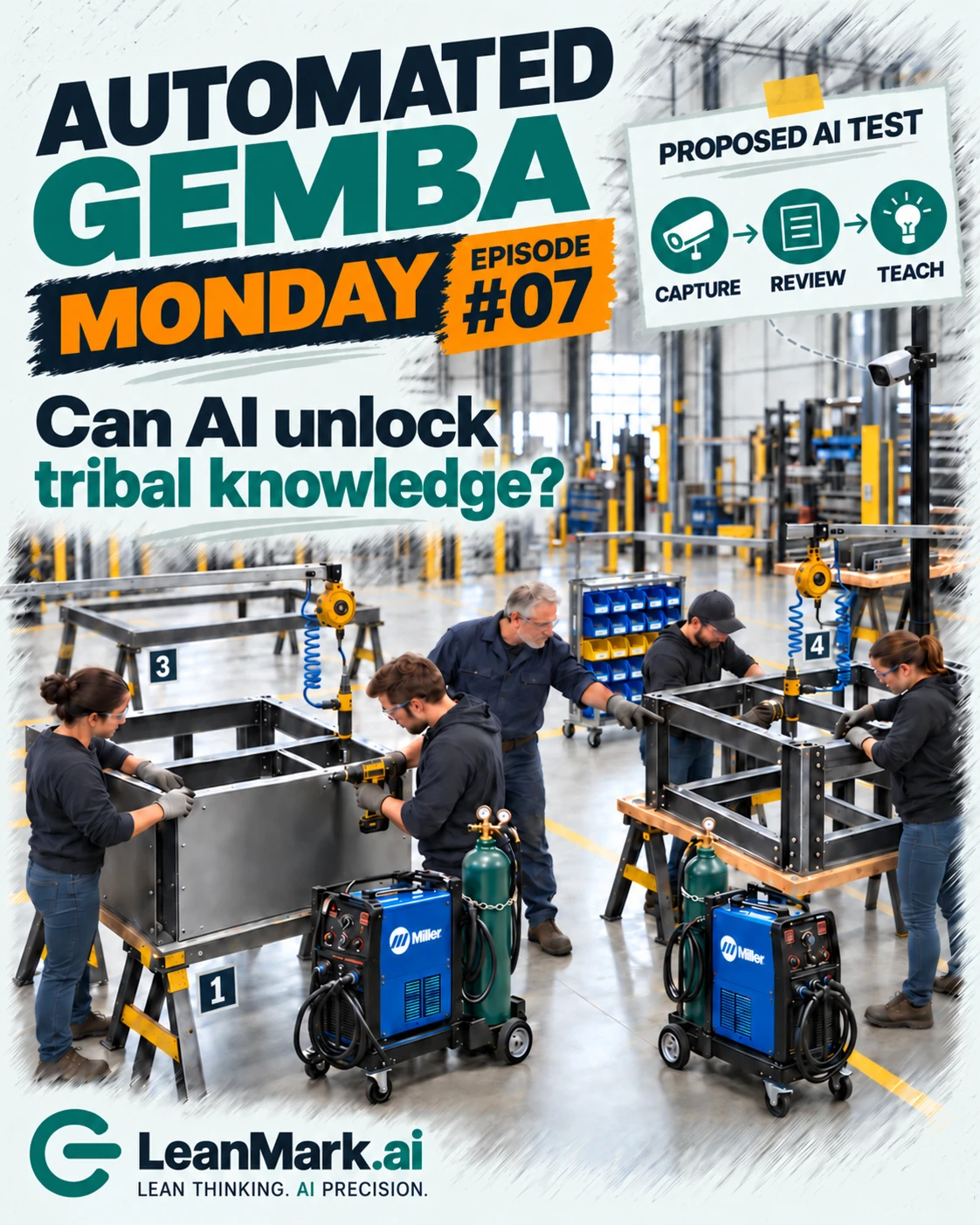
Every shop has that person.
The experienced fabricator who knows the sequence, spots the problem, and figures out how everything fits together. The drawing gives you dimensions. This person knows how to build it.
For us, that was the Fab3, our most experienced skill level.
The goal of this small assembly pilot was to break down that tribal knowledge so less experienced people could do more of the work.
We cleared roughly 2,000 square feet and set up four stations close together. Three very similar assemblies. Four people building them: two intermediate-level Fab2s and two junior Fab1s.
The Fab3 became our conductor.
He stepped in when someone needed guidance or another pair of hands. He answered questions and checked that parts were available. Then he stepped away.
We divided the build into manageable stages: frame, remaining structure, skinning, doors, and finishing details. These were work modules, with several tasks handled at each station.
That was modularization in practice. Smaller pieces of work that people could learn and repeat, with experience available when needed.
From memory, the team completed the three assemblies in about two weeks. We did not establish a measured labor-productivity gain from this pilot.
What mattered most to me was that less experienced people could build these assemblies, and the work flowed.
02 / The interruption
The parts were ready. We thought.
Preparation had cut the sheets for skinning, the outer sheet-metal covering.
We assumed they were correct. When we placed them against the structure, the dimensions did not match.
Information from the engineering order had been transcribed incorrectly during material preparation.
As I remember it, six large sheets were affected. We may have recovered two through rework.
The conductor measured and checked the engineering paperwork. Preparation cut replacements and delivered them to the station.
Assembly waited. Roughly half a day gone.
A check of critical dimensions before cutting the remaining sheets is one improvement I would test today. We would need to measure whether it reduced errors and waiting.
AI could help us capture and share the checking knowledge. The check itself still needs to work.
03 / Define the work
Capture what the expert knows to check
I would start by reconstructing a simple SOP with the team: prepare and check the parts, build the frame, complete the structure, attach the skin, install the doors, and check the assembly.
Then I would work through each stage with the Fab3.
What must be ready? What do you check before moving on? When do you step in, and why?
Those answers are part of the knowledge we wanted to share.
AI could help turn a recording and the expert's explanation into a draft work sequence, checks, and teaching notes. The team would review and correct it before use.
The explanation matters. A camera might show the conductor measuring a panel. That action alone does not tell us whether he is checking normal work, teaching someone, or investigating a preparation error.
04 / Value-added and non-value-added work
VA/NVA needs that same understanding
Making a required connection correctly the first time adds value. Positioning and holding parts supports the current method. Correcting bad material and waiting for replacements are losses.
But the label alone does not tell us what to change.
One person holds a panel while another attaches it. A fixture might make that task easier or reduce the need for holding.
The conductor answers a question. Clearer instructions might help someone handle the same situation independently next time.
Those are useful improvement questions. Simply marking the activity as non-value-added gives us an incomplete answer.
05 / A proposed experiment
The AI test I would try
We have no recording or AI results from this pilot. This is a proposal for a comparable process.
Record one stage, such as skinning, including the expert explaining the important checks. Ask AI to draft a short SOP, then have the team verify it.
Can a less experienced person use those reviewed instructions to complete the stage correctly, with appropriate support?
We would record missed steps, questions, corrections, and when the expert still needed to intervene. Those moments would show us what knowledge remained missing or unclear.
A second check would compare human and AI analysis of the recording. Give both the same SOP and VA/NVA definitions. Compare activity timing, waiting, rework, and uncertain segments.
Review disagreements with someone who knows the process. Agreement alone does not prove either analysis is correct.
And count the time spent reviewing and correcting the AI output. That effort belongs in the result.
Our pilot aimed to make the Fab3's knowledge usable by more people. Dividing the work and making him available as a conductor helped.
AI could help us capture more of his explanations and turn them into instructions the team can use.
I would judge that experiment by what another person can successfully do with those instructions.
That is the next step I would like to test.