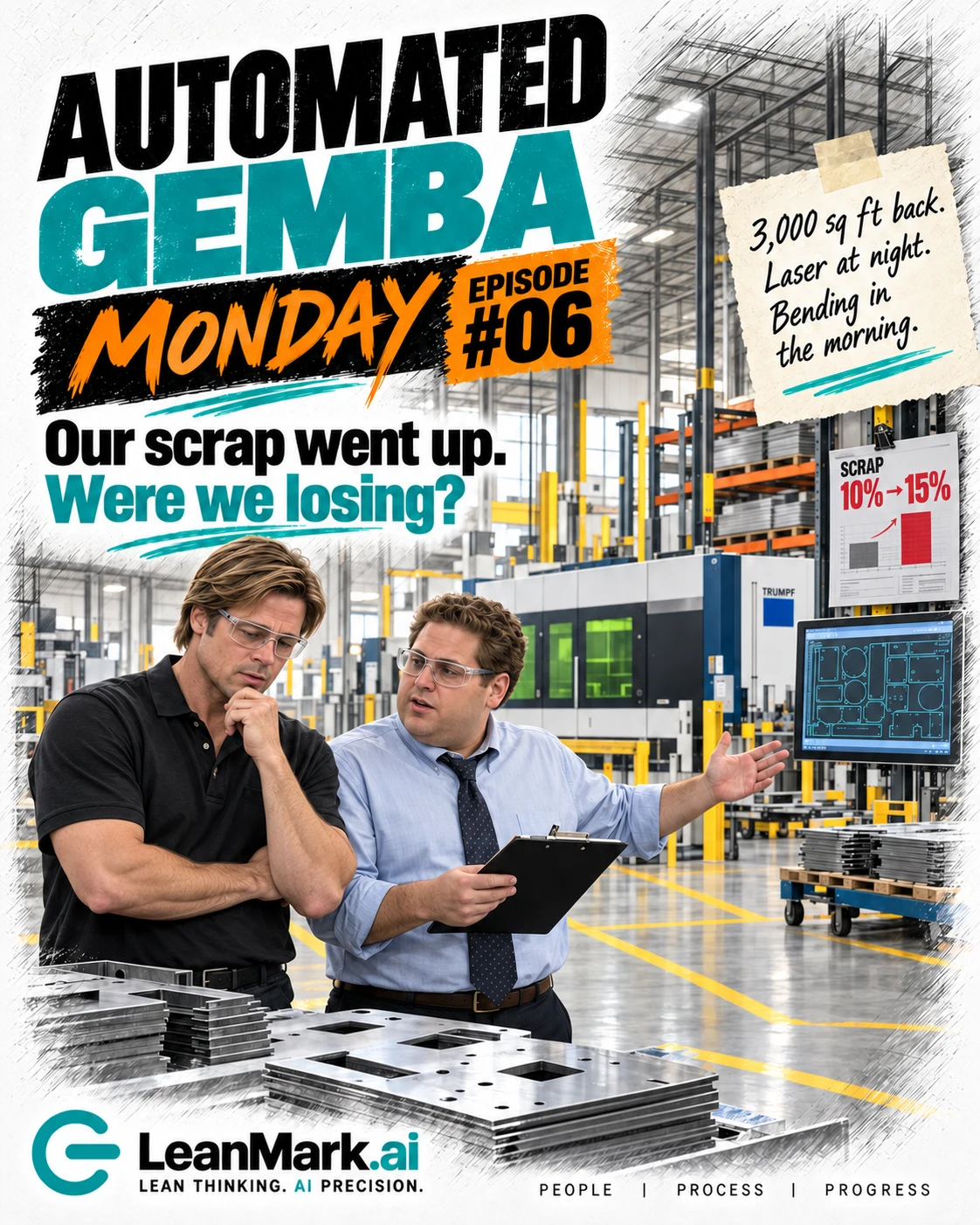
Our scrap went from about 10% to 15%.
If you had judged our move to laser cutting by that number alone, it would have looked like a step backward.
I remember what happened around the machine.
At the partition plant, we had been carrying roughly 20 sheet and blank sizes across different gauges, including 18 and 20 gauge. The inventory was organized around the shear and notching process: pre-sized blanks that still needed trimming and processing.
Blanks typically waited two to three days between shear and notch, then again between notch and bend.
The move to laser brought that range down to about five sizes, stored on two cantilever racks and replenished by the supplier through Kanban.
It freed roughly 3,000 square feet of floor space.
It freed up the person who had been doing cycle counts in that area.
And it took days of waiting out of the route.
Laser at night, bending in the morning.
Fewer sizes to manage. Less inventory to count. Space we could use for production. Days taken out of the lead time.
And yes, a higher scrap percentage.
We arranged those nests by hand. It was a change in how we made the product, years before AI became part of our shop-floor conversation.
The material loss was real. So were the space we recovered, the counting work we eliminated, and the days we removed.
02 / Beyond the scrap bin
The work around the layout
That experience came back to me while reading Tim Heston’s “A Roadmap for Intelligent Nesting” in the October 2026 issue of The Fabricator.
Heston spoke with Lantek’s Victor Muñoz de la Parte and Anupam Chakraborty about current nesting capabilities and where AI could take them.
What caught my attention was how much of the article concerns the work around the layout.
How will the parts be unloaded?
What happens to the small pieces?
Will the blanks form correctly with the tooling available at the press brake?
Those questions reach beyond the scrap bin.
One example describes grouping 49 small steel parts into a mini-nest that suitable magnetic unloading equipment can handle together. That arrangement might sacrifice some material utilization while making unloading easier.
Whether it pays depends on the work saved—and any work added when the parts are separated and finished.
The article also describes sizing blanks using bend simulations based on the actual die widths at the press brake.
The nesting decision reaches into the next operation before the first part is cut.
My own question would go one step further: does the next operation receive what it needs to complete the job?
A sheet can be finished while an order is still waiting for one missing component.
That is why I want material utilization in the same discussion as handling, inventory, kit completion, and lead time.
Five percentage points of additional scrap deserve attention, especially on repeat work. Our experience does not make that loss unimportant. It shows why the scrap percentage alone could not tell us whether the change was worthwhile.
03 / The AI question
Where could AI help?
Heston’s interviewees describe a future in which AI could help predict processing time, machine performance, bottlenecks, and downstream capacity, giving optimization software better information for choosing a manufacturing route.
The article presents that as a direction of development. Many useful nesting capabilities already exist through established rules and optimization; they do not automatically require AI.
For me, the practical test would be whether an AI-assisted recommendation improves what happens on our floor.
Can it recover material yield without adding sorting work?
Can it keep unloading reliable?
Can it help deliver complete kits when the next operation needs them?
Can it protect the flow while improving the nest?
That is the challenge I would put to AI-assisted nesting.
I would want those five percentage points back.
I would also want to keep the 3,000 square feet—and bending in the morning.
04 / Take it to the floor
One question for Monday
What’s one metric you accepted getting worse because the whole operation got better?
The floor tells the truth.
Marek05 / Keep reading
Sources and further reading
Main article: Tim Heston, A Roadmap for Intelligent Nesting, The Fabricator, October 2026, pp. 41–43. Interviews with Victor Muñoz de la Parte and Anupam Chakraborty, Lantek Systems.
Explore 7 supporting articles and research references
- Beyond Nesting: Programming a Faster Workflow ↗SigmaNEST · 2022
- Nesting by Attribute: A Smarter Way to Keep Production Flowing ↗Lantek · 2025
- How Can You Reduce Material Waste Without Disrupting Production? ↗Lantek · 2025
- More Precision, Less Waste ↗Lantek · 2025
- Automated Scheduled Nesting for Flexible Manufacturing ↗Procedia CIRP · 2022 · Abstract and publication record
- Application of machine learning algorithm in the sheet metal industry: an exploratory case study ↗Research article · 2021
- AI-supported grouping, nesting and scheduling ↗Fraunhofer IPA · Research and implementation services
Continue the conversation
What did the whole operation gain?
Tell me which metric got worse, what improved around it, and how you judged the trade-off.
inFind me on LinkedIn